 Coco
CocoStitch Coconut Deck Tech: A Free Body Every Turn, and Every Body Becomes a Card
The Stitch coconut has one line of text: once during your turn, you may play a character with cost 2 or less for free, and if that character was named Lilo or Stitch, a chosen character gets +1 lore this turn. That is the whole ability. No zones, no conditions, no windows. A free cheap body every turn, with a small tip for staying on theme.
The named card is Stitch — Rock Star, a 6-cost Amber character with Shift 4 whose ability, ADORING FANS, reads: whenever you play a character with cost 2 or less, you may exert them to draw a card. Put the two texts next to each other and the deck writes itself. The coconut guarantees the trigger every single turn, so once Rock Star is on the table, every free body is also a card. My working read of this format is that the named card matters more than the coconut ability, and Stitch is the cleanest case I have. The coconut is a discount. The named card is the engine.
This is the full deck tech, built on the same 60 I settled on August 27. Stitch sits in S on my August 27 tier list, next to Mickey Mouse, and I want to be upfront about what that S means: it is ordinal and dated, the two decks I can best defend right now, not a grade against some absolute bar. Card texts checked against the app as of September 5, 2026.
Why these inks
The coconut cares about exactly one group of cards: characters named Lilo or Stitch with cost 2 or less. There are 13 of them in the pool, and their spread decides the ink question before preference gets a vote: seven in Amber, three in Steel, two in Emerald, and one in Ruby (Stitch — Little Rocket, a Rush body that never sees this deck).
Amber is not a choice. It is the coconut’s ink, it holds the named card, seven of the cheap named bodies, and nearly all of the go-wide lore payoffs this deck quests with.
Emerald’s seat is structural. Two of the cheap named bodies are Emerald, Stitch — Naughty Experiment and Stitch — Little Trickster, and so is Morph — Space Goo, the one body in the pool that works as a Shift base for anything. The coconut runs on cheap bodies every single turn, and Emerald deepens exactly that stack, with the Lady and Tramp duals riding along on the pair. What I filled the rest of the ink with is a build choice, not a color requirement: a discard package that reads the whole table, Sudden Chill, Hypnotize, and repeatable versions on Bucky — Squirrel Squeak Tutor, Daisy Duck — Secret Agent and Donald Duck — Distracted Traveler, each copy hitting three hands at once, plus a small loot suite whose first job is digging for the next cheap body when the free-play line threatens to run dry. Stocking the discard for Lilo — Rock Star is a bonus of that suite, not its purpose; she is one card in sixty.
Steel is the third ink, and it pays for the seat several times over. It makes Rhino — Motivational Speaker and Lilo & Stitch — Fun-Loving Friends legal, two duals already pulling their weight. It takes the named body count from 9 to 12. It brings the Bolt package, with Bolt — Superdog as the deck’s ceiling. And it brings Grab Your Sword, a one-card wipe of every opposing board.
The best case against Steel is Sapphire, and it is about resources rather than reach. Cheap Sapphire bodies like Gramma Tala — Storyteller and Ichabod Crane — Scared Out of His Mind go to your inkwell when they are banished, which is worth a lot in a deck that spends two cards of hand every turn, one inked and one played free, against a single draw; my own numbers below say hand fuel is exactly where this deck thins out. Sapphire also carries Ward and Resist to protect the board, and Ludwig Von Drake — All-Around Expert as one more discard body, though a single-target one at a multiplayer table. The cost is the census: Sapphire’s only named card is Stitch — Experiment 626 at cost 3, which never triggers the coconut, so the cheap named count drops from 12 to 9 and the two Amber and Steel duals leave with it. I weight the trigger pool first, so I stayed on Steel. For a worked version of the other answer, purpledtentacle’s Stitch Dogs list runs the Amber, Emerald and Sapphire shell as a full sixty.
This trio is the most common answer, but not the only direction. The build I most want to test is the puppy version: Dalmatian Puppy — Tail Wagger allows any number of copies in a deck, and lists running 20 to 32 of them turn the free play into fuel that cannot run dry, which is this deck’s real weak point. Puppies never turn on the +1 lore and never carry a Shift, so the trade is floor for ceiling. There are also themed shells that keep the engine and swap the supporting cast, like a princess package in Amber; KNOTZ takes one through real games on his channel Tide to Fate (video), and it ends up circling the same Steel or Sapphire question this section started with.
How the engine works
Start with the fact that decides everything else: the free play comes from your hand. Since the August 14 change to the ability, the coconut does not touch your discard, so every free body is a card you drew, held, and spent.
The deck leans into that with 25 characters at 1 and 2 cost, 12 of them named Lilo or Stitch. From turn 1 the shape of a turn is: pay for one body, free-play another. Two characters a turn, every turn, while the rest of the table plays one.
The +1 lore is simple in play: drop the free body, point it at someone, then quest. Lady — Decisive Dog is the default home for it, since on turns you play three characters she quests for 3 on her own. On turns 1 and 2 it mostly evaporates; from turn 3 on it is roughly a lore a turn.
Then Rock Star arrives, usually on turn 4 or 5 by Shift 4 over any cheap Stitch or over Morph — Space Goo, and the turn shape upgrades: free body, exert it, draw a card. The two 5-cost engines copy the coconut from there. Lilo — Rock Star plays a cheap body from the discard every time she quests, which is what all that loot was stocking. Woody — Jungle Guide draws a card and plays a cheap body from hand every time he quests. A developed turn plays three or four characters and draws two or three cards without spending much ink at all.
Two small rules notes for pilots. Grandmother Willow — Ancient Advisor’s discount is not optional and applies to the next character you play, so the order is Willow, then the paid play, then the coconut’s free one, or you waste the discount on a character that was already free. And Lilo — Escape Artist returns from your discard at the start of your turn but enters exerted, so she never draws a card off ADORING FANS; she is still a free body and a Shift base for Lilo — Rock Star.
The numbers, and what they assume
One sentence of assumptions before any number: everything below comes from a 200,000-game simulation in which I draw every turn, nobody interacts with my board or hand, the only cards I pay for are Besties, Assemble! and Nani — Stage Manager, and the opening-hand alter bottoms three or four expensive cards while keeping Rock Stars, cheap bodies and ink. In other words, these are the engine’s own numbers, a floor on the deck’s mechanics and a ceiling on its safety.
With that said:
- A cheap body in hand, which is coconut uptime, sits at 96 to 100 percent through turn 3 and 81 percent on turn 4.
- Stitch — Rock Star has been seen by turn 4 in about two thirds of games (67 percent), but she is in play by turn 4 in only 31 percent, reaching about half of games (51 percent) by turn 6.
- The engine actually running, meaning Rock Star in play and a body in hand to feed her on the same turn, happens in 22 percent of games at turn 5 and climbs to about a third by turn 8.
- Keeping every opening hand as dealt, no alter, drops the numbers eight to thirteen points depending on the line; the named card seen by turn 4 goes from 67 to 54 percent.
The ceiling has its own math. Woody — Jungle Guide, Simba — Pride Protector and Bolt — Superdog are all singletons. At least one of the three shows up by turn 6 in about 61 percent of games. All three together: under 5 percent. So I plan around landing one engine, enjoy two, and treat the three-engine game as a story to tell afterward, not a line to play toward.
The list
Here is the full 60, grouped by the job each package does.
The named card (4)
- 4x Stitch — Rock Star: Shift 4, and the reason every other card is here. Each cheap body you play may exert to draw.
The second Rock Star (1)
- Lilo — Rock Star: Shift 4 over any of the six Lilos. Every quest replays a cheap body from the discard, which is the old version of this coconut living on as a card.
Shift bases at 1 and 2 (8)
- Stitch — New Dog, Stitch — Protector of Frogs, Stitch — Naughty Experiment: 1-cost bases. Naughty Experiment also hands out Reckless, pointing the table’s aggression somewhere else.
- Stitch — Alien Dancer, Stitch — Little Trickster, Stitch — High Badness Level: 2-cost bases with 3 willpower or, in High Badness Level’s case, Challenger +3 while a Lilo is around.
- Bolt — Headstrong Dog: base for Superdog that loots while undamaged.
- Morph — Space Goo: a base for anything with Shift in the deck; playing him free gives no +1 lore.
The Lilos (6)
- Lilo — Making a Wish: 2 lore for 1 cost, the best free play in the deck.
- Lilo — Snow Artist: quests for 2 while any Stitch is in play.
- Lilo — Escape Artist: climbs out of the discard every turn, exerted.
- Lilo — Patient Weaver and Lilo — Junior Cake Decorator: free named bodies whose quests lend their strength to a challenger.
- Lilo — Bundled Up: ignores the first hit on each opponent’s turn, which keeps her alive through pings and undamaged for Superdog.
Cheap Amber with a job (8)
- Lady — Decisive Dog: the default home for the +1 lore, questing for 3 on three-character turns.
- Grandmother Willow — Ancient Advisor: one ink off the next character, Shift cost included. Rock Star for 3.
- Pudge — Controls the Weather: free with a Lilo in play, a second free body that does not spend the coconut.
- Koda — Talkative Cub: you cannot lose lore on opponents’ turns.
- Sebastian — Loyal Crab: 3 lore on a 2-cost body, 4 with the +1.
- Piglet — Pooh Pirate Captain: quests for 3 with two other characters out.
- Grand Councilwoman — Federation Leader: her quest gives every other Alien +1 lore, and this deck runs sixteen Alien cards.
- Pocahontas — Guiding the Tribe: plays a 1-cost for free on arrival.
Emerald loot (4)
- Bobby Zimuruski — Spray Cheese Kid, Lyle Tiberius Rourke — Adventurer for Hire, Scrooge McDuck — S.H.U.S.H. Agent, Strike a Good Match: draw and discard, stocking the discard for Lilo — Rock Star. Lyle drains the table a lore when two cards hit your discard in a turn, and Scrooge bounces home untouched when challenged.
Consistency and draw (8)
- Besties, Assemble! digs four deep for any character, Rock Star included; Nani — Stage Manager digs four for a cheap body.
- Tod — Clever Fox, Gaetan Moliere — Clever Burrower: more loot, Moliere repeatable and Evasive.
- Lady — Family Dog: a body that plays another body.
- Pleakley — Arctic Naturalist: draws with another Alien out, which is nearly always.
- Bolt — Down but Not Out: 4 lore for 3 ink, enters exerted.
- Lucky — The 15th Puppy: exerts to dig three for cheap bodies, and his quest pumps the whole board with four others out.
Table reach (11)
- Sudden Chill, Hypnotize, You Have Forgotten Me, Daisy Duck — Musketeer Spy: every opponent discards, once each.
- Bucky — Squirrel Squeak Tutor: every Shift you make, the table discards. He and Rock Star are from the same nightmare.
- Daisy Duck — Secret Agent, Donald Duck — Distracted Traveler: repeatable table discard on quest.
- Prince John — Greediest of All: Ward, and draws you a card per card your opponents discard.
- Lyle Tiberius Rourke — Cunning Mercenary: each of your characters that dies costs every opponent a lore.
- Prince John — Phony King: his quest taxes 2 lore from each opponent ahead of you.
- Grab Your Sword: 2 damage to each opposing character, your board untouched. Sixteen characters in this deck cost 5 or more and can sing it for free, and Mickey Mouse — Amber Champion joins them as a Singer 8 with two other Amber characters out.
Keeping the board alive (3)
- Mickey Mouse — Amber Champion: your other Amber characters get +2 willpower, which is most of the deck.
- Rhino — Motivational Speaker: +2 willpower for everyone else, stacking with Mickey.
- Mufasa — Betrayed Leader: when banished, flips the top card and plays it free if it is a character.
The 5-cost engines (3)
- Woody — Jungle Guide: Shift 3, including over Morph. Draw a card and play a cheap body every quest.
- Simba — Pride Protector: Shift 3. If he is exerted at the end of your turn, your other characters ready, and ready characters cannot be challenged.
- Bolt — Superdog: Shift 3 over either Bolt or Morph. Every time he readies, 1 lore per other undamaged character you have.
The top (4)
- Stitch — Carefree Snowboarder: repeatable draw on quest, and an Alien for the Councilwoman.
- Lilo & Stitch — Fun-Loving Friends: Shift 3 over any Lilo or any Stitch, Resist +1, Support. Every cheap named body doubles as her base, so she can land as early as turn 3 on top of something that entered play for free. She also counts as being named Lilo, Stitch and Lilo & Stitch, which gives her two extra jobs: legal base for either Rock Star’s Shift 4, and a name that turns on Pudge — Controls the Weather, Lilo — Snow Artist and Stitch — High Badness Level all by herself.
- Stitch — Carefree Surfer: draw 2 on arrival, 8 willpower.
- Tramp — Street-Smart Dog: costs 1 less per character you have, then loots equal to your board size, which incidentally stocks the discard for Lilo — Rock Star.
One structural note: this list runs zero single-target removal on purpose. At a four-player table a card that answers one character answers a third of the problem. The deck’s interaction is Grab Your Sword, Reckless, discard, and deterrence.
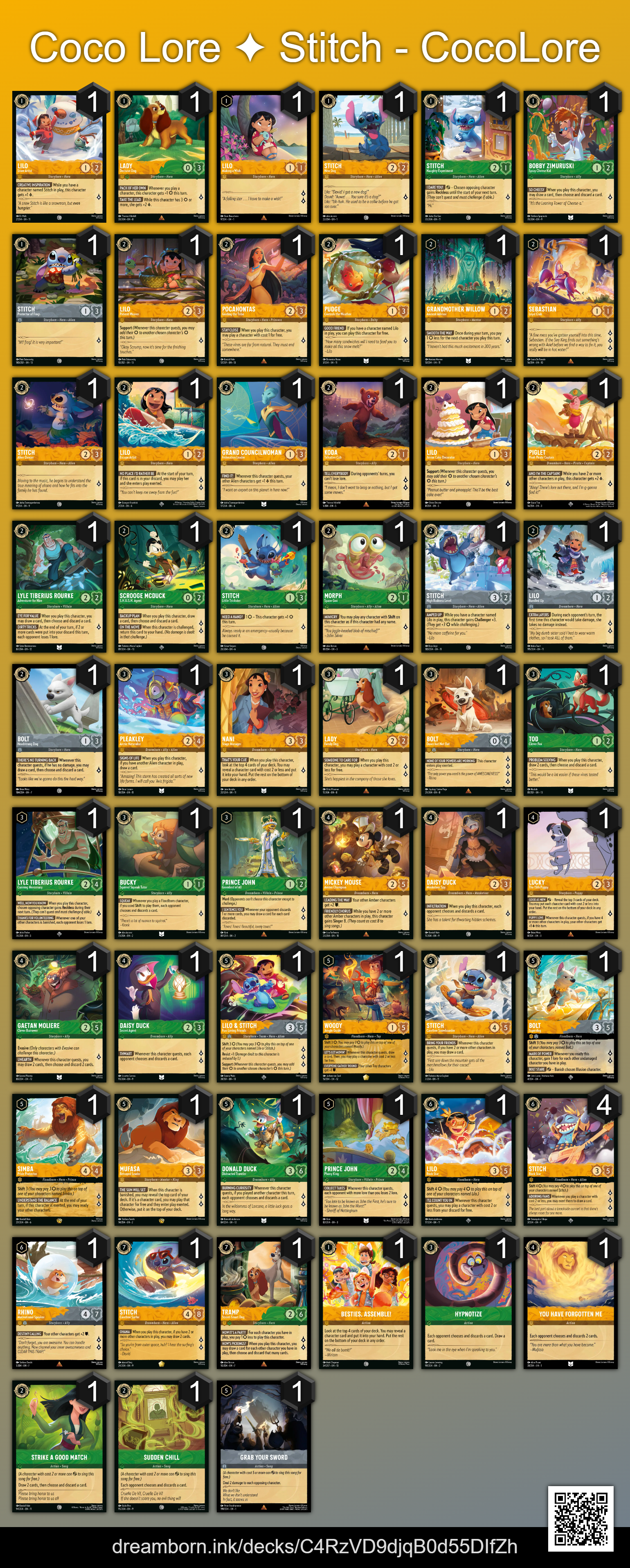
If you want to try it, here is the import block for Dreamborn:
4 Stitch - Rock Star
1 Lilo - Rock Star
1 Stitch - New Dog
1 Stitch - Naughty Experiment
1 Stitch - Alien Dancer
1 Stitch - Little Trickster
1 Morph - Space Goo
1 Lilo - Making a Wish
1 Lilo - Snow Artist
1 Lilo - Escape Artist
1 Lilo - Patient Weaver
1 Lilo - Junior Cake Decorator
1 Lady - Decisive Dog
1 Pudge - Controls the Weather
1 Koda - Talkative Cub
1 Sebastian - Loyal Crab
1 Piglet - Pooh Pirate Captain
1 Grand Councilwoman - Federation Leader
1 Pocahontas - Guiding the Tribe
1 Bobby Zimuruski - Spray Cheese Kid
1 Grandmother Willow - Ancient Advisor
1 Lyle Tiberius Rourke - Adventurer for Hire
1 Scrooge McDuck - S.H.U.S.H. Agent
1 Besties, Assemble!
1 Strike a Good Match
1 Tod - Clever Fox
1 Nani - Stage Manager
1 Lady - Family Dog
1 Pleakley - Arctic Naturalist
1 Lucky - The 15th Puppy
1 Gaetan Moliere - Clever Burrower
1 Sudden Chill
1 Hypnotize
1 Prince John - Greediest of All
1 Bucky - Squirrel Squeak Tutor
1 Lyle Tiberius Rourke - Cunning Mercenary
1 You Have Forgotten Me
1 Daisy Duck - Secret Agent
1 Donald Duck - Distracted Traveler
1 Prince John - Phony King
1 Mickey Mouse - Amber Champion
1 Mufasa - Betrayed Leader
1 Rhino - Motivational Speaker
1 Stitch - Carefree Snowboarder
1 Lilo & Stitch - Fun-Loving Friends
1 Stitch - Carefree Surfer
1 Tramp - Street-Smart Dog
1 Bolt - Superdog
1 Bolt - Headstrong Dog
1 Bolt - Down but Not Out
1 Stitch - High Badness Level
1 Lilo - Bundled Up
1 Woody - Jungle Guide
1 Simba - Pride Protector
1 Stitch - Protector of Frogs
1 Daisy Duck - Musketeer Spy
1 Grab Your Sword
The game plan at a four-player table
Turns 1 to 3. Two bodies a turn, lore from turn 2 through Lady — Decisive Dog, Sebastian and Piglet. Loot aggressively, and dig for cheap bodies first: the free play needs one in hand every turn, and that is the resource that actually runs out. Pitching expensive cards is hand quality, and if Lilo — Rock Star or Lilo — Escape Artist turns up later, the stocked discard is a bonus, not something to plan around. If Bolt — Down but Not Out is in hand, turn 3 is his spot, 4 lore for 3 ink.
Turns 4 and 5. Rock Star arrives by Shift, with Bucky out the table pays a card for the privilege. The loop starts: free body, +1 lore on a quester when the body was a Lilo or Stitch, exert the body, draw. Woody or Lilo — Rock Star over Morph adds a second free body per quest. On a full turn the order matters: Woody quests first (draw, play, exert for a card), then Lilo — Rock Star (body from discard, exert for a card), then the coconut’s free play with the +1 lore aimed at someone still ready, then the lore quests, and Simba last, exerted, so his end-of-turn trigger readies everything behind him.
Turns 5 to 7, the politics. This is the low-profile stretch, and the deck is built for it: exerted 1-drops do not look like a threat, and 3 or 4 lore a turn does not read as a race. Sudden Chill, You Have Forgotten Me and Daisy Duck — Musketeer Spy drain hands while Prince John — Greediest of All refills yours. Koda blanks lore retaliation on their turns. Lyle Tiberius Rourke — Cunning Mercenary is the card to announce out loud: attacking you should look like the worst deal at the table.
The close. Wide boards make cheap bodies quest like finishers, and the pump pieces stack. One sample line of several: Grand Councilwoman — Federation Leader quests first, giving every other Alien +1 lore for the turn, Lucky — The 15th Puppy quests with four others out, giving every other character +1 more, Piglet — Pooh Pirate Captain quests for 3 on his own, and the coconut’s +1 sits on top; with five or six bodies that is a turn of 8 to 12 lore, and the pieces rotate game to game. With Superdog readying over an undamaged board the same turns climb toward 20, and with Simba out he can trigger twice in a cycle, though I am not counting that second trigger yet, for reasons below. Grab Your Sword is a closing tool as much as a defensive one: sing it with Snowboarder, Surfer or Phony King when their quest was not doing much anyway, and save your Rock Star quests for cards. Phony King polices anyone who gets to 23 before you.
What the table should do against you. Attack the hand. The free play needs a body in hand, so every forced discard threatens to turn the coconut off for a turn, and this deck holds 13 cards it cannot ink, which pile up. Challenge the exerted fans; ADORING FANS leaves its own bodies tapped and cheap to remove. Never pass the turn to a wide undamaged Stitch board while Superdog is unaccounted for. And before leaving a board of 1 and 2 willpower bodies in play, count how many of my characters cost 5 or more, because any of them sings Grab Your Sword for free.
Where it breaks
The weaknesses are measurable, so here they are with numbers on them.
The free play spends a card from hand every single turn, and in the simulation with no paid card draw, a cheap body in hand falls from 96 percent on turn 3 to about half by turn 6. The engines are not a luxury on top of a working deck; they are the only thing standing between the coconut and an empty hand. Which is why the worst seat in the format for this deck is across from a discard build: every card they strip is a turn of the coconut, and 13 uninkable cards make the stripping easy.
The engine is a coin flip on schedule. Rock Star in play by turn 6 in about half of games, engine genuinely running on turn 5 in 22 percent, under assumptions that are generous to me. The redundancy behind her is real, four copies, Besties, Assemble! digging four deep for her, and a category of 25 bodies that work without her, but the printed fantasy of the deck shows up in roughly half your games on time, and you should know that going in.
The ceiling is rented, not owned. The Superdog turns and the Simba locks live on singletons with under a 5 percent chance of assembling as a trio by turn 6. And the Simba plus Superdog interaction itself, a mass ready at end of turn triggering MARK OF POWER a second time, is something I have not personally confirmed in the app, so the closing line I most want to play is one I refuse to count yet.
And the honest footnote: the loudest results I have seen for Stitch are from before the August 14 change to the ability. The current version has to re-earn that reputation.
So why does it still sit in S next to Mickey? Because the things that break are the ceiling and the tail, and the things that do not break are the floor and the clock. Two bodies a turn from turn 1 needs no specific card, the scoring band comes from a 25-card category plus a 4-of, and the deck closes on turns 7 and 8, which exactly one other deck in my eighteen does. In a field where every deck pays for its turn size in frequency or its frequency in turn size, Stitch pays the least. That is an ordinal claim, dated August 27, and it is exactly as strong as that sentence sounds.
Flex slots
The list above is a default, not a prescription, so here are the swaps I would actually make and the table conditions that trigger them.
| Out | In | When |
|---|---|---|
| Daisy Duck — Musketeer Spy | Ratigan’s Marvelous Trap | Tables that keep reaching 23-24 before you; the Trap taxes every opponent 2 on your schedule |
| Grandmother Willow — Ancient Advisor | Cursed Merfolk — Ursula’s Handiwork | Challenge-heavy tables; a 2-lore 1-drop that taxes a discard when they hit it |
| Bolt — Down but Not Out | Yzma — Exasperated Schemer | Heavy incidental damage; an undamaged DbNO is exactly what Superdog wants to count |
| Pudge — Controls the Weather | Honey Lemon — Chemical Genius | If Pudge keeps arriving before a Lilo and getting paid for |
| Stitch — Carefree Snowboarder | Perdita — Devoted Mother | Removal-heavy tables; she is a Lilo — Rock Star that skips the Shift |
| Tramp — Street-Smart Dog | Lady — Miss Park Avenue | Recovers two cheap bodies from the discard to hand, two guaranteed coconut turns |
| Hypnotize | Steal from the Rich | Racing tables; with eight questers it drains the table 8 in a turn |
| Stitch — Carefree Surfer | Christopher Robin — Adventurer | A second ready payoff; 2 lore per ready with a full board, twice per cycle with Simba |
| Pleakley — Arctic Naturalist | Bernard — Brand-New Agent | Readies Superdog or Rock Star at end of turn if he is exerted |
| Stitch — Little Trickster | Gosalyn Mallard — The Quiverwing Quack | Readies the body ADORING FANS just exerted, undoing the ability’s one cost |
One card I keep out on purpose: Bend to My Will, the 7-cost Emerald action that makes every opponent discard their whole hand. The discard package I already run tests the table’s patience; this one turns three annoyed players into a coalition, and a deck that wants to be ignored until turn 5 cannot afford to be the table’s villain. The seven ink does not fit the curve either.
And the bigger fork: Sapphire instead of Steel, which comes in two flavors. The resource version is the one from the ink section, built on bodies that ramp from the board and on Ward to hold it. The speed version runs Yokai — Intellectual Schemer, who makes every Shift cost 1 less, which means Rock Star on turn 3, and Hiro Hamada — Intuitive Thinker, who readies a Floodborn for a second quest. Both pay the same bill: the Bolt package, the willpower anthem and Grab Your Sword leave, and the cheap named count drops from 12 to 9. I have not tested either at a table, and I would genuinely like to hear from anyone who has.
What did I miss?
The question I most want answered from an actual table: if you have had Simba — Pride Protector’s end-of-turn ready go off while Bolt — Superdog was in play, did the app pay MARK OF POWER a second time? That one interaction moves my read of this deck’s ceiling more than any card swap in the table above.
Analysis date September 5, 2026, on the August 27 build, texts as of the same day. When the next rework lands, assume this page is wrong until it says otherwise.